What is colorectal cancer? Why regular screening is essential

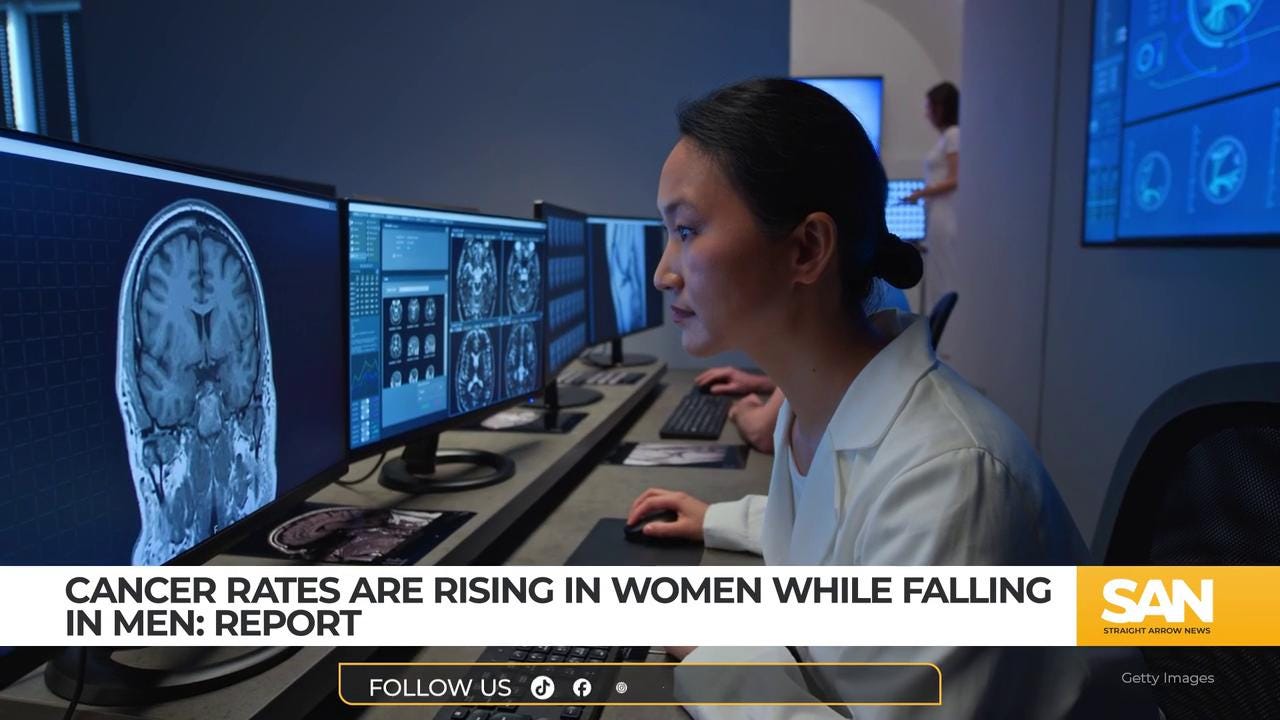

Women see rise in cancer rates as rates in men decrease: Report
Women are seeing a rise in cancer rates while men are experiencing a decline in cancer diagnoses, according to the American Cancer Society.
Straight Arrow News
Colorectal cancer is one of the leading causes of cancer-related deaths in the United States, and as the years pass, it’s clear that the degree of people under 50 that are being diagnosed with the disease is steadily increasing. It’s estimated that diagnoses of early-onset colorectal cancer grew 2.4% every year between 2012 and 2021, per the American Cancer Society.
But what’s the reason behind this? That’s the million dollar question, experts say.
In recent years, studies have taken a closer look at whether certain lifestyle choices might up your risk for colon cancer. For instance, a preliminary study unveiled at the 2025 American Society of Clinical Oncology conference demonstrated a possible association between “intense” long distance running and having an elevated risk for pre-cancerous polyps. But in response to the small-scale study (which to date, hasn’t appeared in a medical journal), experts are calling for additional research to further investigate the causality behind this potential link, the New York Times reported.
It raises the question: Are there any established lifestyle factors that might increase your risk for colorectal cancer? And what are key symptoms to pay attention to?
What is colorectal cancer? Where does it originate from?
“There are a number of different abnormal growths that can occur both in the colon and the rectum,” says Dr. William C. Chapman Jr., a colorectal surgeon at the WashU Medicine Siteman Cancer Center in St. Louis, and co-leader of the Siteman Young-Onset Colorectal Cancer Program.
And while the majority of these growths, otherwise known as polyps, won’t turn cancerous, there are certain features of a polyp that could point to the likelihood of it becoming problematic, says Dr. Ernesto Llano, an instructor at the Department of Internal Medicine at UT Southwestern Medical Center who specializes in inflammatory bowel disease and colon cancer. A polyp could be considered high risk if it’s large in size, or exhibits specific changes under the microscope, says Llano.
“When we talk about polyps in the colon or rectum, the adenomas are the ones that are thought to have the highest risk of turning to cancer,” says Chapman. Advanced adenomas are “a pre-cancerous lesion that has (a) risk of turning into a cancer if left to its own devices,” he explains.
When people refer to colorectal cancer, what they’re most often referring to is an adenocarcinoma, a malignant growth that starts in the lining of the colon or the rectum (also known as the mucosa), says Chapman. “These tumors are glandular tumors, and their behavior can be a little bit different depending on which part of the colon or rectum they originate in,” he says.
Do all polyps need to be removed?
Not necessarily, though the presence of polyps definitely calls for a closer look. If your colonoscopy screening reveals you “have polyps, that is predictive that you will make more in the future,” says Llano. “The more polyps you have, the higher (the) risk of cancer,” he says.
“There are certain polyps that have less cancer risk associated with them,” says Chapman. But nowadays, there’s some thought that there might be a pre-cancer risk associated with polyps previously considered to be harmless. “So, in general, if we are seeing any kind of polyp, we’re often talking about removing them, except for some very specific circumstances,” he says.
What’s clear is that “whenever we find or see adenomas, whether they’re advanced or not, we always recommend resecting them to prevent the development of a cancer down the road,” says Chapman.
Why are more young people getting colorectal cancer?
“Why this is happening now, we can’t definitively say,” Chapman notes. There’s some thought that an increase in diagnoses of early-onset colorectal cancer could be exacerbated by differences in screening for younger versus older patients. “But that, in and of itself, doesn’t account for the whole story,” he says.
It’s also well known that having a family history of colorectal cancer or a genetic predisposition to certain conditions (such as Lynch syndrome) may increase your risk for developing the disease, says Llano. “But a lot of the early-onset cancers that we’re finding are not related to inherited genetic mutations or syndromes that may run in a family. They are isolated tumors that have arisen de novo (all on their own),” Chapman adds.
You can’t change your family history, but what role does lifestyle play? According to the ACS Cancer Facts & Figures 2024 report, around 55% of colorectal cancers might be able to be traced to a few potential risk factors, such as: lack of exercise, excessive smoking and alcohol consumption, excess body weight, eating lots of red and processed meats, and not getting enough calcium, whole grains and fiber in your diet.
That said, “the causes of colon cancer are still not well understood,” says Llano. That’s why we need “a broad screening program across the population,” he says.
What are key symptoms of colorectal cancer?
The signs of colon and rectal cancer are relatively non-specific, says Chapman. Potential symptoms could include abdominal discomfort, diarrhea, blood in the stool, rectal bleeding and constipation, per the ACS. “One of the tough things about colon and rectal cancer is that you typically don’t develop symptoms until relatively late in that cancerous process,” says Chapman.
Colorectal cancers are often found when they are metastatic, which is why it’s essential to stay on top of regular screenings, such as a colonoscopy or stool-based testing, once you reach age 45, says Llano.
And if you have a family history of colorectal cancer or polyps, a doctor might recommend you start getting colonoscopies even earlier than age 45. “We hope that by finding cancers earlier, even in younger patients, we can decrease mortality and improve treatment outcomes for those populations,” says Chapman.
link